Request Info Enroll Now

Welding and Cutting Technology

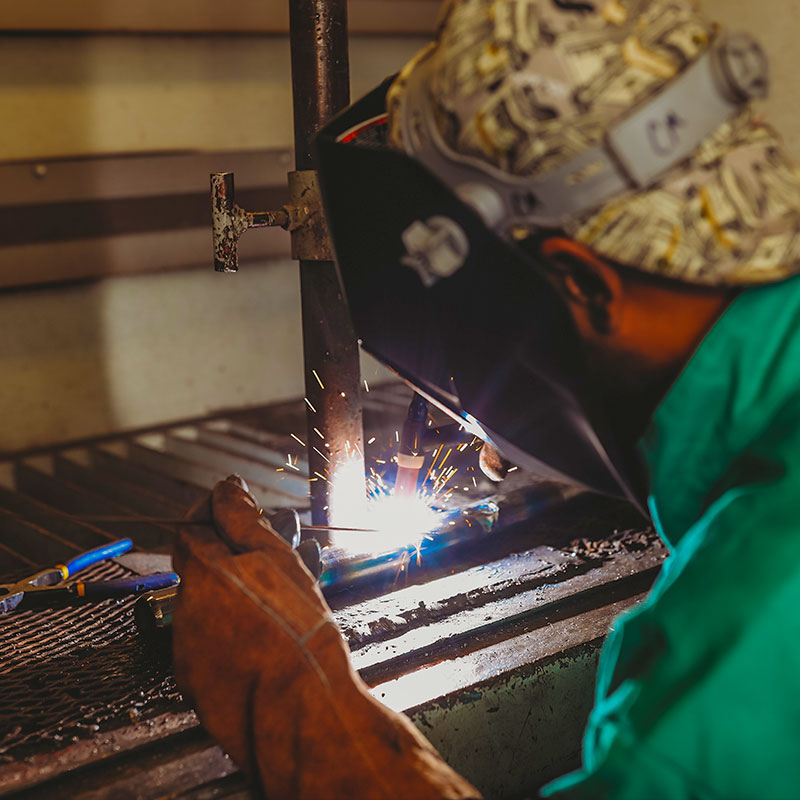
The Welding and Cutting Technology program prepares students for entry-level employment in the field of welding and cutting. Students will develop skills in the use of arc welders, oxyacetylene torches, and plasma cutting machines. Gas tungsten arc welding techniques are taught on both ferrous and nonferrous materials. Classroom instruction is provided in blueprint, welding, welding theory, and welding machines.


WELDING AND CUTTING TECHNOLOGY

Program Curriculum

ASSOCIATE OF APPLIED SCIENCE

FIRST YEAR:
First Semester
  • Shielded Metal Arc Welding I (SMAW) WLT 1115
    WLT 1115 - Shielded Metal Arc Welding I (SMAW). This course is designed to teach students welding techniques using the SMAW process. One hour lecture. Eight hours laboratory. Five hours credit.
  • Introduction to Welding and Safety WLT 1173
    WLT 1173 - Introduction to Welding and Safety. This course is designed to give student an introduction to the welding profession and experience in safety procedures related to welding. Two hours lecture. Two hours laboratory. Three hours credit.
  • Shielded Metal Arc Welding II WLT 1225
    WLT 1225 - Shielded Metal Arc Welding II. This course is designed to teach students advanced welding techniques using the SMAW process. One hour lecture. Eight hours laboratory. Five hours credit.
  • Cutting Processes WLT 1313
    WLT 1313 - Cutting Processes. This course is designed to give the student experience in oxyfuel cutting principles and practices, air carbon cutting and gouging, and plasma arc cutting. One hour lecture. Four hours laboratory. Three hours credit.
  • Work-Based Learning I WBL 1911
    WBL 1911 - Work-Based Learning I. Work-Based Learning offers supervised work experience for Career Technical majors in which the student, Work-Based Learning Coordinator/Instructor, and worksite supervisor/mentor develop and implement a business/education training agreement. Work-Based Learning is designed to integrate the student's academic and technical skills into a work environment. Six semesters of Work-Based Learning are offered with 1-3 semester hours credit available per semester and summer sessions. Credit is awarded based on the following chart: 45 clock hours at work per semester = 1 hour credit 90 clock hours at work per semester = 2 hours credit 135 clock hours at work per semester = 3 hours credit A maximum of six hours of WBL credits may be substituted for technical courses (required or elective) upon the approval of the student's advisor, the campus Career Technical Director, and the Career Technical Vice President.
Total 17 Hours
Second Semester
  • Blueprint Reading, Welding Symbols, and Metallurgy WLT 1232
    WLT 1232 - Blueprint Reading, Welding Symbols, and Metallurgy. This course is designed to give the student experience in blueprint reading, welding symbols, and metallurgy. One hour lecture. Two hours laboratory. Two hours credit.
  • Gas Metal Arc Welding (GMAW) WLT 1124
    WLT 1124 - Gas Metal Arc Welding (GMAW). This course is designed to give the student experience in various welding applications with the GMAW process using various modes of transfer. One hour lecture. Six hours laboratory. Four hours credit.
  • Gas Tungsten Arc Welding (GTAW) WLT 1135
    WLT 1135 - Gas Tungsten Arc Welding (GTAW). This course is designed to give the student experience in various welding applications using the GTAW process. One hour lecture. Eight hours laboratory. Five hours credit.
  • Flux Cored Arc Welding (FCAW) WLT 1143
    WLT 1143 - Flux Cored Arc Welding (FCAW). This course is designed to give the student experience using FCAW process. One hour lecture. Four hours laboratory. Three hours credit.
  • Smart Start Pathway SSP 1002
    SSP 1002 – Smart Start Pathway. Students will enroll in the MS Works system and learn three components within the pathway: Career Awareness, Necessary Skills, and Basic Skills. They will develop the foundational skills needed for their careers, learn and practice good work habits and effective communication that is necessary in successful employment. Students will learn how to become prepared to learn new skills for future careers within their region’s workforce sector, identifying the career components that are necessary for middle-skill employment. Students will complete the WorkKeys® assessment in Workplace Documents, Applied Math, and Graphic Literacy which allows students to quantify the foundational skills needed to perform job tasks successfully and enables students to demonstrate they have these skills. Upon completion of this assessment, students will earn a National Career Readiness Certificate, a credential issued by ACT that documents work readiness.
Total 16 Hours
SECOND YEAR:
First Semester
  • Pipe Welding WLT 1154
    WLT 1154 - Pipe Welding (Prerequisites: WLT 1115 & 1225). This course is designed to give the student experience in pipe welding procedures. One hour lecture. Six hours laboratory. Four hours credit.
  • Advanced Pipe Welding WLT 1252
    WLT 1252 - Advanced Pipe Welding. This course is designed to give the student advanced pipe welding techniques using shielded metal arc and gas tungsten arc welding processes. One hour lecture. Two hours laboratory. Two hours credit.
Total 6 Hours
Second Semester
  • Social/Behavioral Science Elective (3)
  • Humanities/Fine Arts Elective (3)
  • English Composition II ENG 1123 OR Public Speaking I SPT/COM 1113 OR Social/Behavioral Science (3)
  • College Algebra MAT 1313 OR Natural Science w/Lab (4)
Total 12 Hours

(Option One) A Technical Certificate may be earned after successfully completing the first 33 hours of career technical coursework.

(Option Two) An Advanced Technical Certificate may be earned after successfully completing the first 48 hours of career technical coursework.

(Option Three) An AAS Degree may be earned after successfully completing required career technical and academic coursework.

*Approved Electives: WLT 1162, WLT 191(1-6), WLT 192(1-6), WLT 2812, WLT 2913, or any other technical or academic course approved by advisor

Enrollment in a minimum of 15 hours each semester is recommended for eligibility for state aid, institutional scholarships, and the tuition break.